
Product questions
Here you will find an overview of our common abbreviations:
| Abkürzung | Bedeutung |
|---|---|
| GTX | Gore-Tex |
| Ws | Women's models (smaller sizes, narrower lasts) |
| T | Textile lining |
| LTR | Leather upper material |
| C | CrafTex upper material |
| LL | Leather lining |
| V | Suede leather |
| N | Nubuck leather |
| WTR | Winter |
Labeling of the categories of safety footwear EN ISO 20345
SB: protective toe cap + slip resistance basic requirement
S1: protective toe cap + slip resistance basic requirement + closed heel area + antistatic + energy absorption in the heel area
S2: protective toe cap + slip resistance basic requirement + closed heel area + antistatic + energy absorption in the heel area + water-repellent upper material
S3: protective toe cap + slip resistance basic requirement + closed heel area + antistatic + energy absorption in the heel area + water-repellent upper material + metal penetration protection
S3L: protective toe cap + slip resistance basic requirement + closed heel area + antistatic + energy absorption in the heel area + water-repellent upper material + non-metallic penetration protection type PL
S3S: protective toe cap + slip resistance basic requirement + closed heel area + antistatic + energy absorption in the heel area + water-repellent upper material + non-metallic penetration protection type PS
S6: protective toe cap + slip resistance basic requirement + closed heel area + antistatic + energy absorption in the heel area + water-repellent upper material + waterproofness of the entire shoe
S7: protective toe cap + slip resistance basic requirement + closed heel area + antistatic + energy absorption in the heel area + water-repellent upper material + waterproofness of the entire shoe + metal penetration protection
S7L: protective toe cap + slip resistance basic requirement + closed heel area + antistatic + energy absorption in the heel area + water-repellent upper material + waterproofness of the entire shoe + non-metallic penetration protection type PL
S7S: protective toe cap + slip resistance basic requirement + closed heel area + antistatic + energy absorption in the heel area + water-repellent upper material + waterproofness of the entire shoe + non-metallic penetration protection type PS
Labeling of the categories of occupational footwear EN ISO 20347
OB: slip resistance basic requirement
O1: slip resistance basic requirement + closed heel area + antistatic + energy absorption in the heel area
O2: slip resistance basic requirement + closed heel area + antistatic + energy absorption in the heel area + water-repellent upper material
O3: slip resistance basic requirement + closed heel area + antistatic + energy absorption in the heel area + water-repellent upper material + metal penetration protection
O3L: slip resistance basic requirement + closed heel area + antistatic + energy absorption in the heel area + water-repellent upper material + non-metallic penetration protection type PL
O3S: slip resistance basic requirement + closed heel area + antistatic + energy absorption in the heel area + water-repellent upper material + non-metallic penetration protection type PS
O6: slip resistance basic requirement + closed heel area + antistatic + energy absorption in the heel area + water-repellent upper material + waterproofness of the entire shoe
O7: slip resistance basic requirement + closed heel area + antistatic + energy absorption in the heel area + water-repellent upper material + waterproofness of the entire shoe + metal penetration protection
O7L: slip resistance basic requirement + closed heel area + antistatic + energy absorption in the heel area + water-repellent upper material + waterproofness of the entire shoe + non-metallic penetration protection type PL
O7S: slip resistance basic requirement + closed heel area + antistatic + energy absorption in the heel area + water-repellent upper material + waterproofness of the entire shoe + non-metallic penetration protection type PS
Classification of fire brigade footwear in accordance with the CE 0197 EN15090 standard
Code 1: Shoes made of leather or other materials, except footwear made entirely of rubber or polymers
Code 2: Footwear made entirely of rubber or polymers
Types of brigade footwear in accordance with the EN 15090 standard
Type 1: Suitable for general technical deployments (e.g. Type 1, HI1) and fire fighting outdoors only (e.g. Type 1 HI2; Type 1 HI3)
Type 2: Heavy duty basic protection models, suitable for internal fire fighting and combating other fires of all sorts; standard fire brigade boots (e.g. Type 2 HI2; Type 2 HI3)
Type 3: Special protective version, suitable for deployment in exceptional risk situations such as those involving hazardous materials; also suitable for all sorts of fire fighting (e.g. Type 3 HI2; Type 3 HI3)
Type and protective function of fire brigade footwear is stated in the bottom left-hand corner of the pictogram (fire fighter), e.g. F2A, whereby the following applies:
F Fulfils all requirements under the standard
2 Type 2
A Fulfilment of antistatic requirements
Meaning of the labelling symbols
HI1: Heat insulation performance level of the sole design at 150°C / 30 minutes
HI3: Heat insulation performance level of the sole design at 250°C / 40 minutes
Did you choose the correct shoe size?
Please remove the insoles from your shoes and stand on them. It is important that your heels are flush with the insoles. The marked PerfectFit area will tell you whether the size you have chosen is suitable.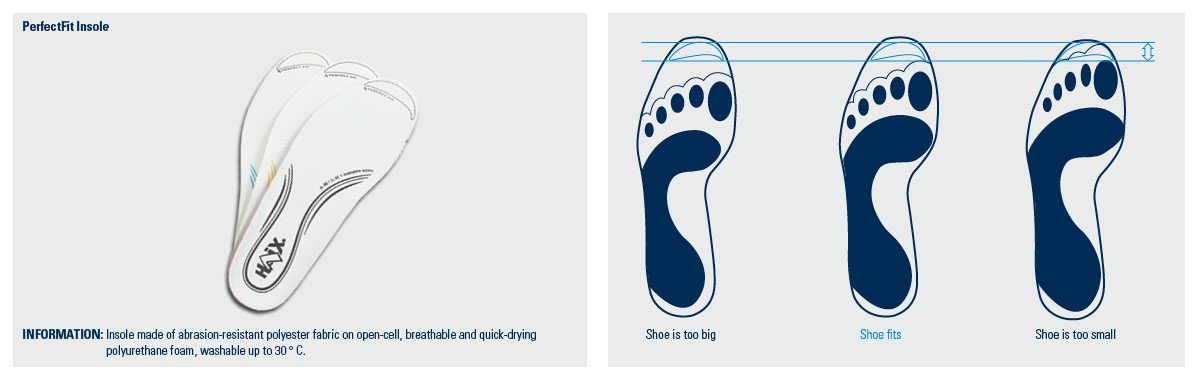
The Vario-Fit insoles are compatible with some of our shoes. Simply search for the right insoles for your shoe model at Accessoires and go to "Select size". If there are different types of insoles, you can choose between narrow, normal and wide foot. If your shoes are too narrow for you, the yellow insoles are ideal for the wide foot.
Please feel free to contact our customer support team so that we can offer you personalised advice. You can reach us either via the chat function at the bottom right of the online shop or by phone on +49 (0) 8751 / 8625 888. As we use different lasts depending on the model, our shoes may vary in fit.
Please remove the insoles from your shoes and stand on them. It is important that your heels are flush with the insoles. The marked PerfectFit area will tell you whether the size you have chosen is suitable.
Vario-Fit insoles are compatible with some of our shoes. Simply search for the right insoles for your shoe model at Accessoires and click on "Select size". If there are different types of insoles, you can choose between narrow, normal and wide foot. If your shoes are too big for you, the blue insoles are ideal for narrow feet.
Please contact our customer support team for advice: [email protected] or +49 (0) 8751 / 8625 888. We produce on different lasts depending on the model - not all shoes are the same.
Instructions for custom-made orthopedic insoles with the HAIX® CO System
Are you looking for a specific model and can't find it in our webshop? It might be a special or discontinued model.
Would you like more information about this shoe? Please contact us:
The reason for this is that very large sizes are only infrequently requested by customers. This means that production costs are higher than for standard sizes. Production processes also need to be specially adjusted, for example, and material use is greater. Nevertheless, we wish to be able to continue to provide this particular service to our customers. We are, therefore, compelled to charge an oversize supplement for shoes which do not correspond to the usual sizes.
HAIX shoes are 100% Made in Europe. For us, this is not just lip service, but lived practice. When it says "Made in Europe" on a HAIX shoe, we assure you that it was made exclusively at our production sites in Mainburg and Mala Subotica, Croatia. Both plants are among the most modern shoe manufacturing facilities in the world.
By the way: "Made in Europe" is not only a promise of quality for us, but also stands for good working conditions, equal opportunities, sustainability and corporate responsibility.
| Product Name | Upper Material | Gore-Tex | Metal-Free |
|---|---|---|---|
| BLACK EAGLE Safety 40.1 | Textile | yes | yes |
| BLACK EAGLE Safety 41.1 | Textile | no | yes |
| BLACK EAGLE Safety 50.1 | Leather (1.8 - 2.0), without abrasion protection over the toe cap | yes | yes |
| BLACK EAGLE Safety 50 | Leather (1.8 - 2.0) | yes | yes |
| BLACK EAGLE Safety 50 high | Leather (1.8 - 2.0) | yes | no |
| BLACK EAGLE Safety 53 | Suede leather (2.0 - 2.2) | yes | yes |
| BLACK EAGLE Safety 54 | Leather (2.0 - 2.2) | yes | no |
| BLACK EAGLE Safety 56 | Leather (2.0 - 2.2) | no | no |
| BLACK EAGLE Safety 56 LL | Leather (2.0 - 2.2), with leather lining | no | no |
| BLACK EAGLE Safety Pro | Cut-resistant textile | yes | yes |
| BLACK EAGLE Safety 200 | M, T | Microfibre/textile | no | yes |
| BLACK EAGLE Safety 400 | C, GTX | CrafTex | yes | yes |
| BLACK EAGLE Safety 410 | C, GTX | CrafTex | yes | yes |
| BLACK EAGLE Safety 600 | LTR, GTX | Leather (2.0 - 2.2) | yes | no |
| BLACK EAGLE Safety 600 | V, GTX | Suede leather (2.0 - 2.2) | yes | yes |
| BLACK EAGLE Safety 610 | LTR, T | Leather (2.0 - 2.2) | no | yes |
| BLACK EAGLE Safety 610 | V, GTX | Suede leather (2.0 - 2.2) | yes | yes |
| BLACK EAGLE Safety 610 | LTR, GTX | Leather (2.0 - 2.2) | yes | no |
| BLACK EAGLE Safety 610 | LTR, LL | Leather (2.0 - 2.2), with leather lining | no | yes |
| BLACK EAGLE Safety 630 | LTR, GTX | Leather (2.0 - 2.2) | yes | yes |
Our BLACK EAGLE Safety models offer you the highest comfort and safety. Except for the slightly narrower women's models (marked with 'Ws'), all models are produced on the same last and have consistent sizing. Additionally, they are certified to safety class S3 and are suitable for orthopedic insoles, ensuring reliable protection in demanding work environments.
BLACK EAGLE Athletic & BLACK EAGLE Tactical
Our BLACK EAGLE Athletic and Tactical models differ only in the materials used for the upper:
GTX: Gore-Tex (waterproof)
T: not waterproof
N: Nubuck leather
V: Suede leather
The rest is made of textile or smooth leather. All models are certified according to occupational footwear standards and are suitable for orthopedic insoles.
The BLACK EAGLE Adventure models are identical in construction to our BLACK EAGLE Athletic and Tactical series. The upper material is textile, and the women's models (marked with 'Ws') are narrower. The main difference: these models do not meet any professional standards and are considered purely leisure shoes.
The key difference between these two models is water resistance. Our CONNEXIS Go models are equipped with Gore-Tex, making them waterproof, whereas the CONNEXIS Air models are not waterproof.
Our CONNEXIS Force Air stands out for its high-quality and lightweight nubuck leather, making it the ideal leisure shoe for warm days.
A shoe is considered antistatic if the measured resistance falls within the range of 100 kiloohms (10^5 ohms) to one gigaohm (10^9 ohms). Antistatic shoes must be used according to standards to reduce electrostatic charge and ensure its dissipation. This is necessary when the risk of electric shock from electrical devices or live parts cannot be ruled out, or when there is a risk of igniting flammable substances or vapors due to sparks. The goal is to protect the wearer of the safety shoes (and also people in the vicinity) from hazards associated with electrical charge.
For ESD-capable shoes, the lower limit of resistance is also 100 kiloohms, but the upper limit is 100 megaohms (1 x 10^8 ohms). This means that an ESD-capable shoe is always antistatic as well. However, an antistatic shoe is not automatically ESD-capable. ESD-capable shoes protect not only the wearer and those nearby but also safeguard workpieces and equipment through controlled dissipation.
Nubuck leather is sanded smooth leather, while suede is made by splitting and then roughening the leather. Both types of suede leather appear velvety in texture. Suede is particularly known for being very durable and easy to care for.
The HAIX Climber and the HAIX Protector Alpin are able to accommodate crampons.
Outdoor